← Home · Roadway

CBR Study for Road Design in Anaheim — Geotechnical Laboratory

Together, we solve the challenges of tomorrow.

LEARN MORE →

Anaheim sits on deep alluvial deposits of the Santa Ana River floodplain, with silty sands and low-plasticity clays extending 15 to 25 meters below grade. Groundwater fluctuates seasonally between 3 and 6 meters depth, which directly influences the moisture conditioning of subgrade soils for pavement design. A CBR study for road design in Anaheim must account for this variable moisture regime to avoid overestimating subgrade strength during dry months. We follow ASTM D1883-21, compacting samples at Proctor optimum and soaking them for 96 hours to simulate the worst-case saturation the pavement will face over its service life. The soaked CBR value becomes the design input for flexible pavement thickness in accordance with Caltrans and AASHTO 1993 guidelines.
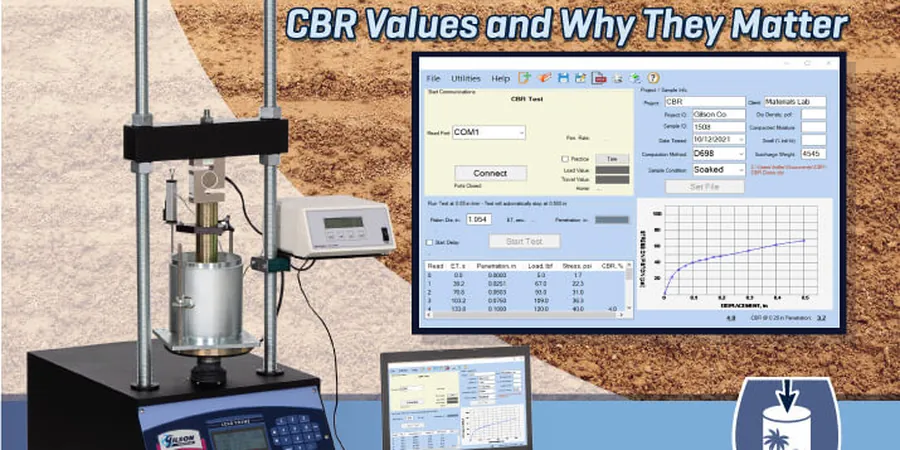
Illustrative image of Cbr vial in Anaheim
Soaked CBR from 3 to 25 in the same soil unit: our testing protocol captures that spread before the pavement design is sealed.

Methodology and scope

What we see repeatedly in Anaheim is that the same soil unit can yield CBR values from 3 to 25 depending on compaction energy and moisture at the time of testing. That spread matters, because pavement designs based on a single unsoaked value can fail within two years. Our protocol includes at least three penetration points per compaction energy level, and we pair the CBR study with a subgrade soil classification to identify fines content and plasticity that control the swell potential. For projects near the Santa Ana River channel, we also recommend a permeability test to evaluate drainage under the pavement section. The final report delivers the design CBR, the expansion percentage after soaking, and the recommended structural number for the asphalt layer. We also note the soil's AASHTO group and USCS symbol to support the pavement engineer's decision on whether a treated base is needed.
Technical reference image — Anaheim

Local considerations

The Mediterranean climate of Anaheim brings long dry summers followed by intense winter storms. That seasonal cycle drives the biggest risk for road pavements: the subgrade dries and gains apparent strength during summer, then wets up and loses CBR by half or more during the rainy season. If the CBR study for road design in Anaheim is run on air-dried samples without the mandatory 96-hour soak, the design thickness can be dangerously thin. We also see risk from the expansive clays present in the eastern Anaheim hills — these soils can swell 4 to 6 percent upon wetting, heaving the pavement surface and cracking the asphalt if the CBR swell test is omitted. Our lab always reports the expansion percentage alongside the soaked CBR so that the engineer can decide on a lime-treated or geogrid-reinforced base before placing the hot mix.

Need a geotechnical assessment?

Reply within 24h.

Email: contact@geotechnicalengineering1.biz

Technical parameters

ParameterTypical value
StandardASTM D1883-21, AASHTO T-193
Sample preparationCompacted at Proctor optimum moisture, 3 energy levels (10, 25, 56 blows)
Soaking period96 hours with swell measurement every 24 h
Penetration rate1.27 mm/min (0.05 in/min)
Surcharge weight4.54 kg (10 lb) — simulates pavement overburden
Reported valuesCBR at 2.54 mm and 5.08 mm, expansion %, moisture after soak

Associated technical services

01

CBR on Recompacted Field Samples

When the project requires site-specific density and moisture, we extract undisturbed tube samples or bulk bags from the subgrade at the proposed compaction level. The CBR test is then run on recompacted material at field density and at Proctor optimum, giving two design scenarios. This service is common for Anaheim arterial roads where the existing subgrade is a mix of native alluvium and imported fill.

02

CBR Swell & Expansion Index

For Anaheim residential streets and collector roads underlain by high-plasticity clays, we extend the standard CBR test to include continuous swell monitoring for 96 hours. The expansion index (ASTM D4829) is reported alongside the soaked CBR. This data is critical when deciding whether to specify a lime-treated subgrade or a granular capping layer to control heave.

Applicable standards

ASTM D1883-21 — Standard Test Method for California Bearing Ratio, AASHTO T-193 — Standard Method of Test for the California Bearing Ratio, ASTM D698 / D1557 — Standard Proctor / Modified Proctor compaction, ASTM D4318 — Atterberg Limits (for plasticity and swell correlation)

Frequently asked questions

How does the 96-hour soak affect the CBR value for Anaheim soils?

In our experience, Anaheim silty sands lose 40 to 60 percent of their unsoaked CBR after the standard 96-hour soak. The alluvial clays from the eastern part of the city can lose even more, dropping from 15 to 5. The soaked value is the one that governs the pavement design thickness.

What is the typical price range for a CBR study for road design in Anaheim?

For a standard CBR test at three compaction energies with full 96-hour soak and swell report, the price ranges between US$190 and US$310 per sample. The variation depends on whether the sample is submitted already compacted or if we prepare it from bulk material, and on the number of penetration points required.

Can I use the CBR value from a nearby Anaheim project for my current design?

Not reliably. The alluvial deposits in Anaheim vary significantly in sand-clay ratio over short distances, and the groundwater level shifts seasonally. A CBR study for road design in Anaheim must be run on material from the actual subgrade at the proposed compaction moisture to be valid for design. Borrowing values from a site two blocks away can lead to under-design or over-design of the pavement section.

Location and service area

We serve projects across Anaheim and its metropolitan area.

View larger map