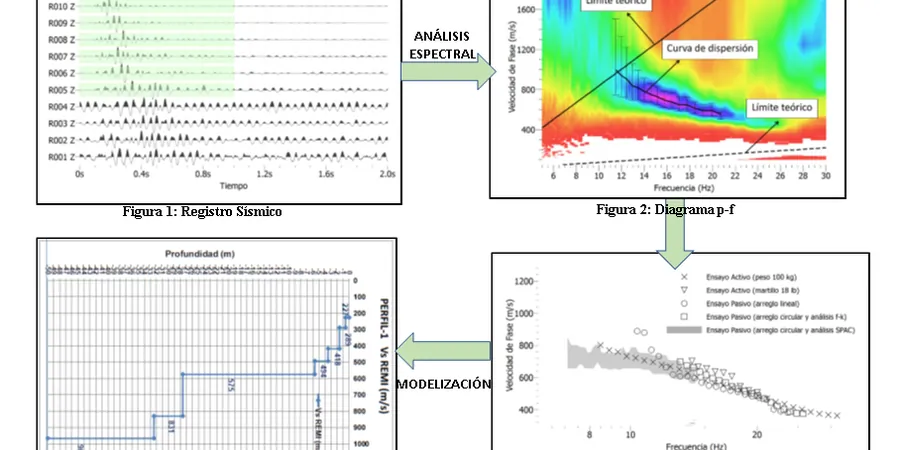
The soil in Anaheim varies a lot from the west side near the 57 freeway to the east near the Santa Ana River. West of Harbor Boulevard you often find older alluvial deposits with stiffer sands and gravels. East of the 57, closer to the river, the ground is looser and more recent. That difference matters for seismic site classification. A MASW survey measures shear wave velocity directly in the field. We use that data to assign the ASCE 7 site class — C, D, or E. This is critical for designing foundations in Anaheim that resist earthquake shaking. We combine the MASW profile with a geotechnical soil study to cross-check the stratigraphy and correlate wave speeds with soil types.
MASW provides a continuous shear wave velocity profile to 30 meters depth in less than a day — no borehole needed.
Method and coverage
We see many projects in Anaheim where the client needs VS30 for the building code but only has borehole data. That gives you point values, not a continuous profile. MASW fills that gap. It covers a linear array of 70 to 100 meters along the ground surface. We use a 24-channel seismograph and low-frequency geophones. The result is a 2D shear wave velocity section down to 30 meters. The VS30 value is the time-averaged velocity over the top 30 meters. We process the data using frequency-wavenumber analysis and inversion algorithms. The whole survey takes less than a day, including setup. For deep profiles we sometimes pair it with a CPT test to get cone resistance at the same location. That gives you both stiffness and strength from one visit.
Technical reference image — Anaheim
Regional considerations
A 10-story hotel project in the Platinum Triangle area of Anaheim once moved forward with only SPT data from two boreholes. The N-values pointed to site class D. After we ran a MASW line, the VS30 came out at 210 m/s — that is site class E. The design spectrum changed completely. The structural engineer had to add shear walls and increase column sizes. That cost rework and a two-week delay. If they had done the MASW at the start, the design would have been correct on the first pass. Seismic site classification in Anaheim is not something you guess. The code requires hard numbers. We provide them.
Single 70-meter array with 24 geophones. VS30 and 2D velocity section. Ideal for small to mid-size commercial projects in Anaheim.
02
Multi-Line MASW for Large Sites
Three or more parallel and perpendicular lines. Generates a 3D velocity model. Used for master-planned developments and apartment complexes.
03
MASW + Borehole Correlation
MASW survey at existing borehole locations. We compare the velocity profile with SPT N-values and soil classification for a calibrated site class.
04
Re-MASW for Existing Structures
MASW along accessible pavement or open ground near existing buildings. Used for seismic retrofit evaluations and foundation upgrade designs.
Standards that apply
ASTM D4428 / D4428M – Standard Test Method for MASW, ASCE 7-22 – Minimum Design Loads, Site Class Definitions, IBC 2021 – Chapter 16, Seismic Ground Motion
Quick answers
How much does a MASW survey cost in Anaheim?
The cost typically ranges between US$1,680 and US$3,340 for a standard single-line survey. The final price depends on site access, array length, and whether overnight data processing is needed. Contact us for a quote specific to your Anaheim project.
What is VS30 and why does it matter for building in Anaheim?
VS30 is the average shear wave velocity in the top 30 meters of soil. The ASCE 7 code uses VS30 to assign the site class (A through F). That class directly sets the seismic design parameters for your foundation and structure. In Anaheim, site classes D and E are common due to the alluvial soils.
Can MASW replace boreholes for site classification?
MASW can replace boreholes for VS30 if the goal is only site class. But for foundation design you still need soil samples and index tests. We recommend MASW as a complement to SPT or CPT, not a full replacement. It gives the continuous velocity profile that boreholes miss.
How deep does the MASW survey reach in Anaheim soils?
With a 70-meter array and low-frequency geophones (4.5 Hz), we consistently reach 30 meters depth in the alluvial deposits of Anaheim. In stiffer ground we can go deeper — up to 40 meters — but the standard target is the top 30 meters for VS30.
How long does it take to get the MASW results?
Field work takes 3 to 5 hours for a single line. Data processing and the final report with VS30 and velocity sections are delivered within 3 business days. Rush service is available for 24-hour turnaround if needed.