Anaheim sits at an average elevation of just 160 feet, but the city’s northern edge rises sharply into the Santa Ana Mountains foothills. That transition zone — where flat valley floor meets steeper terrain — is exactly where slope stabilization design becomes critical. In our lab, we’ve processed hundreds of soil samples from developments along Canyon Road, East Street, and the areas near the 91 Freeway. The alluvial fans and colluvial deposits in these zones can hide loose layers or clay seams that trigger progressive failure under heavy rain. Before any retaining wall or cut slope goes in, we run a full study of soil mechanics to define shear strength, groundwater depth, and the actual failure surface geometry.
A pseudo-static coefficient of 0.20g can drop a slope’s factor of safety from 1.5 to below 1.2 if a weak clay layer is present.
Method and coverage
A typical hillside project in Anaheim involves a 25- to 40-foot cut into weathered granitic bedrock mixed with old terrace deposits. We start by correlating field blow counts from SPT borings with lab triaxial tests to get realistic cohesion and friction angles. Then we model the slope using a limit-equilibrium approach — usually Bishop simplified or Spencer’s method — to compare factors of safety under static and seismic conditions. Because Anaheim falls within Seismic Design Category D per IBC, the pseudo-static coefficient picks up at 0.20g to 0.25g horizontal acceleration. That alone can drop a factor of safety from 1.5 to below 1.2 if the soil profile includes a weak clay layer. Complementing the analysis with MASW testing for Vs30 helps us refine the site class and avoid over-conservative reinforcement designs that inflate project budgets.
Technical reference image — Anaheim
Regional considerations
The biggest hazard we see in Anaheim slopes is the combination of old alluvial clay layers perched on top of dense, fractured bedrock. Rain events in El Niño years can raise the groundwater table 10 to 15 feet in just a few days, saturating that clay and reducing its effective stress dramatically. Without a proper slope stabilization design that accounts for transient seepage, the factor of safety can drop below 1.0 in hours. We’ve documented cases where shallow translational slides occurred on lots that looked stable during dry summer inspections. That’s why we always model the worst-case saturated condition, even if the site is bone-dry when the borings are drilled.
Measured via UU triaxial (ASTM D2850) or direct shear (ASTM D3080)
Seismic coefficient (kh)
0.20g – 0.25g for SDC D (IBC 2021)
Target factor of safety (static)
≥ 1.5 (FHWA-NHI-05-039)
Soil unit weight
115 – 130 pcf (typical for Anaheim colluvium)
Groundwater depth
Often > 30 ft except after heavy winter storms
Maximum slope angle (cut)
2H:1V to 1.5H:1V depending on bedrock quality
Complementary services
01
Limit-Equilibrium Stability Modeling
We run Bishop simplified, Spencer, and Janbu analyses using actual lab-measured shear strengths and site-specific groundwater conditions. Output includes factor of safety for static, seismic, and rapid-drawdown scenarios.
02
Reinforcement Design & Sizing
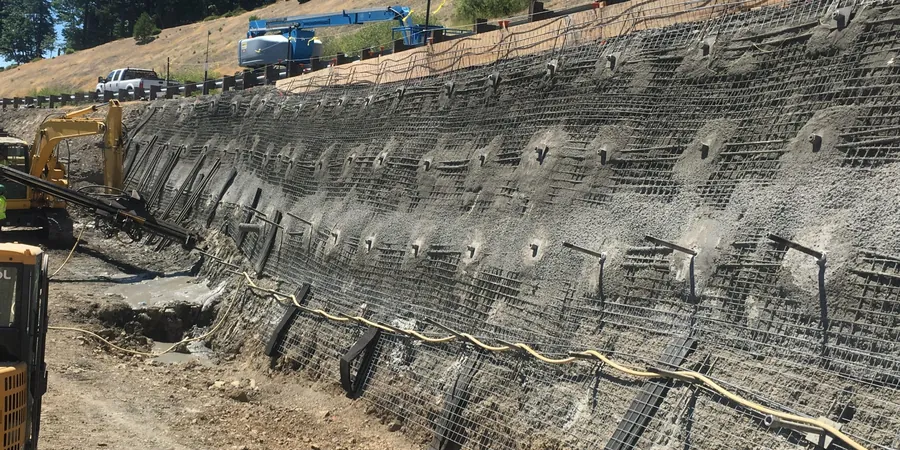
When the safety factor falls short, we design soil nails, tieback anchors, or geogrid-reinforced fills. We size each element per FHWA guidelines and provide construction-ready cross-sections.
03
Construction-Phase Monitoring
During excavation, our field technicians install inclinometers and surface monuments to track real-time movement. We compare readings against predicted behavior and alert the team if thresholds are exceeded.
How much does a slope stabilization design study cost in Anaheim?
A complete study — including field borings, lab testing, stability modeling, and a design report — typically ranges between US$1,700 and US$7,070. The final price depends on slope height, access difficulty, and the number of reinforcement options evaluated.
What factor of safety is required for slopes in Anaheim?
For static conditions, most Orange County jurisdictions require a minimum factor of safety of 1.5 for permanent slopes. Under seismic loading (0.20g–0.25g pseudo-static), acceptable values drop to 1.1–1.2. These thresholds follow FHWA-NHI-05-039 and local grading ordinances.
Do I need a geotechnical report for a small retaining wall on a hillside lot?
Yes — any retaining wall taller than 3 feet that supports a surcharge or is built on a slope of 3H:1V or steeper typically requires a geotechnical evaluation. The report must include soil shear strength, groundwater conditions, and lateral earth pressures per IBC Chapter 18.
Can slope stabilization be designed without drilling borings?
No. Reliable design requires at least one boring per slope segment to recover undisturbed samples for lab testing. Surface observations alone cannot detect weak clay layers, perched water, or bedrock irregularities that control failure surfaces.
Process video
Location and service area
We serve projects across Anaheim and surrounding areas.