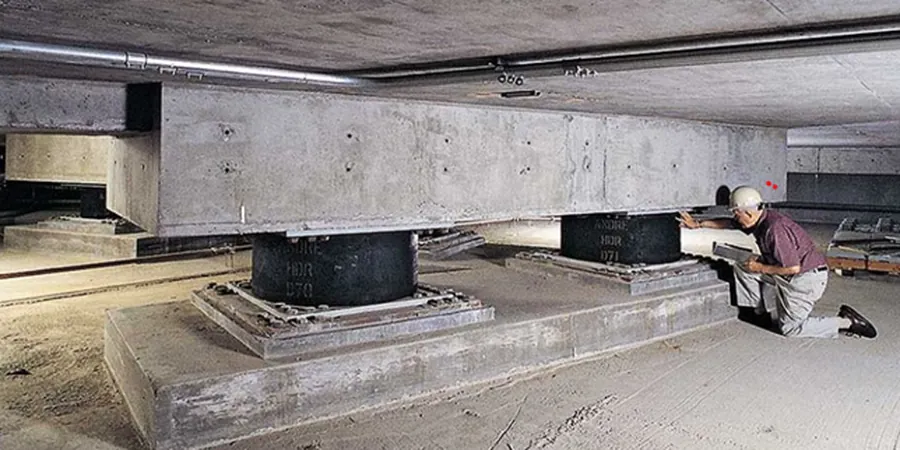
A mixed-use project near the Anaheim Convention Center needed foundation design for a 15-story tower over alluvial soils. The groundwater table sits at roughly 12 feet, and the site class under ASCE 7 is D — stiff soil with potential for amplification. We developed a seismic foundation design that combined spread footings on improved ground with deep piles at the core. Before finalizing the geotechnical model, we ran a MASW-Vs30 survey to map shear-wave velocity profiles across the lot, and a seismic response analysis to capture site effects down to 30 meters. The approach cut foundation costs by 18% compared to the initial full-pile scheme.
Seismic foundation design in Anaheim must account for soil amplification and liquefaction potential under MCE shaking.
Method and coverage
We bring a mobile geotechnical laboratory trailer to Anaheim job sites, equipped with a hollow-stem auger rig and a CPT truck for continuous profiling. The standard scope includes SPT borings to 25 meters with automatic hammers to meet ASTM D1586-18 energy requirements. We pair those with undisturbed tube sampling for triaxial and consolidation testing. On a recent project near Angel Stadium, the team used a preload surcharge program to accelerate consolidation of the upper clay layer before designing the shallow footings. The seismic foundation design incorporated a deep soil mixing grid to stiffen the upper 6 meters and reduce differential settlement under cyclic loading.
Technical reference image — Anaheim
Regional considerations
Anaheim sits on the Santa Ana River floodplain, underlain by Holocene alluvium — loose sands and soft clays that amplify seismic waves. The 1933 Long Beach earthquake (M6.4) caused widespread liquefaction and foundation failures in similar deposits within 10 miles of the city center. Under the current IBC, a 7-story building on shallow footings without Improvement would likely exceed tolerable settlements during the design earthquake. We incorporate cyclic triaxial and resonant column tests to capture modulus reduction and damping curves specific to the local soil layering.
One-dimensional ground response analysis using DEEPSOIL or equivalent linear code. We incorporate measured Vs30 and modulus reduction curves to generate design spectra for ASCE 7 Site Classes C through F.
02
Liquefaction Triggering Assessment
SPT-based and CPT-based simplified methods per NCEER (Youd-Idriss 2001). We calculate factor of safety against liquefaction at each depth and recommend mitigation strategies such as stone columns or deep soil mixing.
03
Shallow Foundation Design for Seismic Loads
Bearing capacity and sliding checks under combined gravity and seismic loads. We include dynamic bearing capacity reductions for cohesive soils and recommend Improvement when allowable pressures are exceeded.
04
Deep Foundation Design — Pile Groups
Axial and lateral load analysis for driven piles and drilled shafts. We run p-y curve analyses using LPILE to capture soil-pile interaction under cyclic loading, and we check group effects for spacing ratios below 3D.
Standards that apply
ASCE 7-22 — Minimum Design Loads for Buildings (seismic chapters), IBC 2021 — International Building Code (Chapter 18), ASTM D1586-18 — Standard Test Method for SPT, NCEER 1997 — Recommended Procedures for Liquefaction Evaluation
Quick answers
What is the typical cost range for a seismic foundation design study in Anaheim?
The cost for a site-specific seismic foundation design package in Anaheim — including field borings, laboratory testing, response analysis, and final foundation recommendations — typically falls between US$1.240 and US$4.110, depending on building height, soil variability, and the number of borings required.
Do I need a site-specific response spectrum for a 3-story building in Anaheim?
Yes, if the building falls under Risk Category II or higher and the site is on Site Class D or worse, the IBC requires a site-specific ground motion analysis for structures over 2 stories. We run simplified equivalent linear analyses that often reduce design forces compared to the default mapped values.
How deep should borings go for seismic foundation design?
Borings must penetrate at least 30 meters or extend to a depth equal to 2 times the foundation width, whichever is greater. For high-rise towers, we extend borings to 40 meters to capture the full soil column affecting the seismic response.
What is the difference between liquefaction triggering and liquefaction-induced settlement?
Liquefaction triggering calculates the factor of safety against pore pressure buildup in each soil layer. Liquefaction-induced settlement estimates the vertical strain after triggering, using post-liquefaction volumetric strain curves (Ishihara & Yoshimine 1992). Both are required for a complete seismic foundation design in Anaheim's alluvial zones.
Can I use the same foundation design for Anaheim as for a site in nearby Irvine?
No — soil profiles vary significantly within a few miles due to the alluvial fan deposits from the Santa Ana and Santiago Creek systems. Anaheim typically has thicker Holocene sands and silty clays, while Irvine has older Pleistocene terrace deposits with higher stiffness. A site-specific investigation is non-negotiable for code compliance.
Location and service area
We serve projects across Anaheim and surrounding areas.