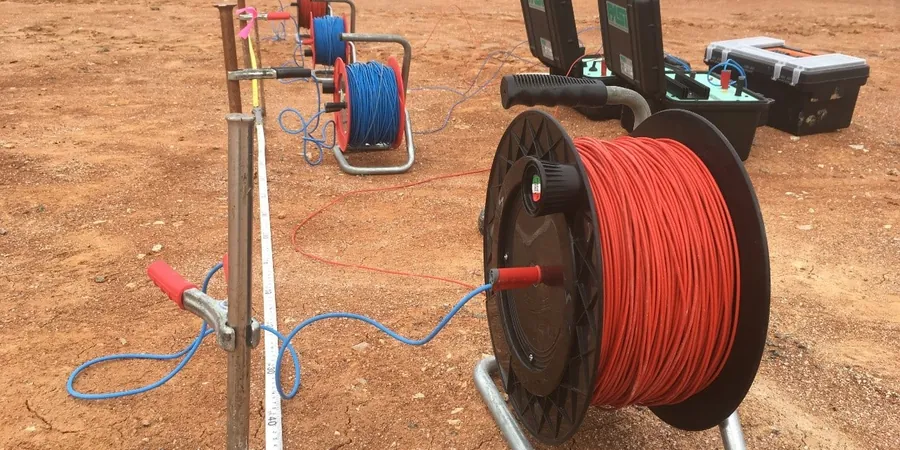
I remember walking a site near the Santa Ana River corridor where a developer was planning a mid-rise residential complex. The soil profile looked uniform at surface, but we knew from past Anaheim projects that old river deposits can hide abrupt changes in resistivity. Running a Vertical Electrical Sounding (VES) across that lot revealed a shallow clay lens nobody expected, saving the structural engineer from assuming uniform bearing conditions. That kind of surprise is exactly why we integrate electrical resistivity surveys early in the design phase. Before you set footing depths or design drainage, it helps to know where the conductive layers sit, and a VES profile gives you that without drilling a dozen holes first. Combining this with a focused soil classification program gives you a complete picture of the subsurface before you break ground.
A single VES profile can map shallow clay lenses and groundwater zones across a 200-meter line in one day, saving weeks of exploratory drilling.
Method and coverage
Anaheim sits roughly 160 feet above sea level, but the alluvial fans from the Santa Ana Mountains create a patchwork of sand, silt, and gravel layers. Electrical resistivity works well here because the contrast between dry alluvial sands and clay-rich zones is clean enough to map with confidence. We typically deploy a Schlumberger array with electrode spacings between 20 and 200 meters, depending on target depth. The field crew runs the survey in a single day for most residential parcels, and the inversion models come back within 48 hours. Key parameters we resolve include:
Apparent resistivity curves for each sounding point
Layer thickness and true resistivity for up to 4 horizons
Estimated depth to groundwater (when resistivity drops below 50 ohm-m)
Correlation with clay content using Archie's law parameters
A common mistake we see in Anaheim is contractors relying solely on one or two borings to characterize a whole lot. With the historic floodplain of the Santa Ana River cutting through the city, resistivity can vary by a factor of 10 within 50 feet laterally. I've seen a project where a single SPT boring missed a buried paleochannel filled with loose sand, and the foundation settled unevenly after the first rainy season. An electrical resistivity survey would have caught that transition. Skipping this step means you're designing foundations blind to lateral variability, and in Anaheim's alluvial environment, that's a real gamble. The cost of the survey is negligible compared to the risk of differential settlement or unexpected groundwater seepage during excavation.
One-dimensional resistivity sounding at a single location. Best for estimating depth to groundwater or clay layers beneath a proposed footing. Typical depth range 20-50 m.
02
2D Resistivity Profiling
Multi-electrode array producing a continuous cross-section of subsurface resistivity. Ideal for mapping lateral changes across a building footprint or linear infrastructure.
03
Resistivity for Groundwater Exploration
Targeted surveys to locate zones of high conductivity that indicate perched or shallow groundwater. Helps de-risk excavations and design dewatering systems.
04
Corrosion Potential Assessment
Measurement of soil resistivity to evaluate corrosion risk for buried utilities, tanks, or steel piles. Data reported per ASTM G57 with recommendations for cathodic protection.
Standards that apply
ASTM G57-20 (Standard Test Method for Field Measurement of Soil Resistivity), ASTM D6431-18 (Standard Guide for Using the Direct Current Resistivity Method), ASCE 7-22 (Minimum Design Loads — site characterization requirements)
Quick answers
How deep can a VES survey reach in Anaheim's alluvial soils?
With a maximum electrode spacing of 200 meters, we can resolve layers down to about 60 meters in dry alluvial sands. In areas with conductive clay, the depth of investigation may reduce to 30-40 meters due to signal attenuation. We adjust the array spacing based on your target depth.
How does electrical resistivity compare to drilling borings?
Resistivity gives you continuous lateral coverage without the cost of multiple boreholes. It doesn't replace borings for soil sampling or lab testing, but it tells you where to place those borings for maximum value. We often run VES lines first, then target only the critical zones with SPT or CPT.
What is the typical cost of an electrical resistivity survey in Anaheim?
A standard VES survey with 5 soundings and interpretation runs between US$650 and US$1,060 depending on site access and depth requirements. Larger 2D profiles covering several hundred meters cost more but still represent a fraction of the cost of additional borings.
Can resistivity detect groundwater in Anaheim's old river channels?
Yes, and that's one of its main strengths. Groundwater typically shows resistivity below 50 ohm-m, while dry sands can exceed 500 ohm-m. The contrast is sharp enough to map buried channels and perched water tables that standard borings might miss.
Location and service area
We serve projects across Anaheim and surrounding areas.