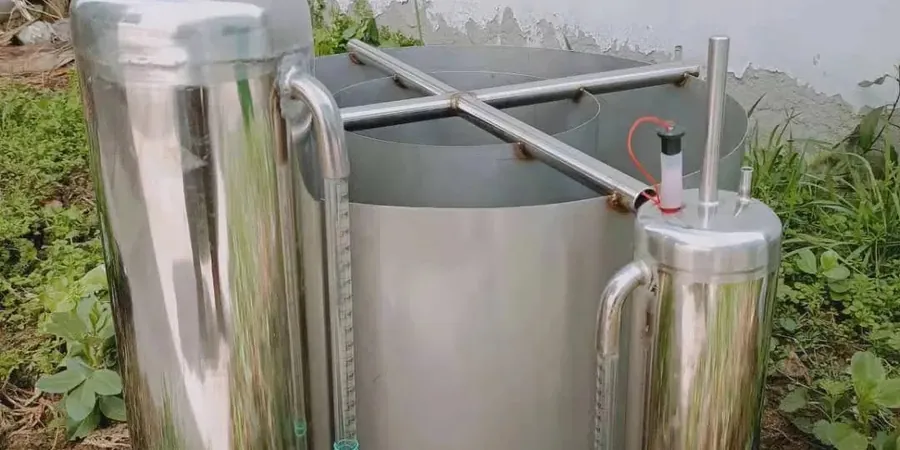
We deploy double-ring infiltrometers and Porchet auger-hole setups across Anaheim, from the Santa Ana River corridor to the residential tracts near Angel Stadium. The rig consists of two concentric steel rings driven 15 cm into the ground, a constant-head Mariotte siphon, and a graduated reservoir. We record falling-head readings every minute until steady-state flow is reached. For drainage basins near Ball Road and the I-5, we run three separate test locations per site to capture the variability of the alluvial sands and silty clays. The field team logs each reading directly into a tablet running ASTM D3385-18 calculation sheets. Results are reported as saturated hydraulic conductivity (Ksat) in cm/s or in/hr, depending on the client's design code. This data is essential for sizing infiltration basins, drywells, and permeable pavement systems. We also cross-reference the field results with lab falling-head tests on undisturbed samples when the project requires Caltrans Section 68-2 compliance.
We measure vertical percolation until three consecutive readings show less than 5% change, then apply a safety factor of 2 to 4.
Method and coverage
Anaheim's subsurface is dominated by young alluvial deposits from the Santa Ana River, with interbedded sands, silts, and gravels that can shift from 10⁻³ cm/s to 10⁻⁵ cm/s within 50 meters. The shallow groundwater table, typically 10 to 25 feet deep, affects infiltration rates significantly. We always run the test until three consecutive readings show less than 5% change. Our double-ring setup prevents lateral flow, so the measured rate reflects vertical percolation only. For projects near the Orange County groundwater basin, we combine the infiltration test with a resistivity survey to map preferential flow paths and with SPT borings to correlate permeability with soil density. The field team uses the Porchet method in boreholes when the water table is within 1.5 m of the surface. We document the test depth, initial head, and final Ksat value on each log. The final report includes the raw data sheet, the steady-state graph, and a clear recommendation for the design infiltration rate (usually applying a factor of safety of 2 to 4 per Caltrans guidelines).
Technical reference image — Anaheim
Regional considerations
The biggest mistake we see in Anaheim is relying on a single infiltration test location. The alluvial deposits here are highly variable — a test pit 20 feet away can show a tenfold difference in Ksat. If you size a drywell or infiltration basin based on one reading, you risk clogging, surface ponding, or worse, groundwater mounding that affects adjacent slabs. We always recommend at least three test pits per acre and a minimum of one per drainage management area. Another common issue: testing during the dry season when the soil is desiccated and cracks are open. That gives artificially high rates. We pre-wet the test area for 24 hours to simulate saturated conditions. For sites near the former industrial corridor along the 91 freeway, we also check for soil contamination before running the test; hydrocarbons or solvents can alter the soil structure and invalidate the results. The soil classification test done in parallel helps identify collapsible or expansive layers that could change permeability over time.
Inner 30 cm, outer 60 cm (double-ring); 10 cm borehole (Porchet)
Head maintained
Constant head 5–15 cm (double-ring); falling head (Porchet)
Steady-state criterion
≤5% change over three consecutive 1-min readings
Measured parameter
Saturated hydraulic conductivity Ksat (cm/s or in/hr)
Reporting format
Raw data table, steady-state graph, recommended design Ksat with safety factor
Applicable standards
ASTM D3385, D5126, Caltrans Section 68-2, Orange County LID Manual
Complementary services
01
Double-Ring Infiltrometer Test (ASTM D3385)
Full field setup with concentric rings, constant-head Mariotte system, and steady-state logging. Suitable for permeable pavement, bioretention basins, and vegetated swales. Includes three test locations per 10,000 sq ft and a report with Ksat values and design recommendations.
02
Porchet Auger-Hole Infiltration Test
Falling-head test in a 10 cm borehole, used where the water table is within 1.5 m of the surface. Ideal for drywell design and shallow retention systems. We measure the head drop over time and calculate Ksat using the Porchet formula (ASTM D5126).
03
Pre-Wetting and Saturation Cycle
24-hour pre-wetting of the test area to replicate field-saturated conditions. Essential for dry-season testing in Anaheim's alluvial soils. We document the pre-wetting volume and duration, then run the standard infiltration test. This service is often bundled with the double-ring test.
Standards that apply
ASTM D3385-18 (Standard Test Method for Infiltration Rate of Soils in Field Using Double-Ring Infiltrometer), ASTM D5126-15 (Standard Guide for Comparison of Field Methods for Determining Hydraulic Conductivity), Caltrans Standard Specifications Section 68-2 (Infiltration Testing), Orange County Low Impact Development (LID) Hydromodification Manual
Quick answers
How does the double-ring infiltrometer test work and what does it measure?
Two concentric steel rings are driven into the ground and filled with water. The inner ring measures vertical infiltration; the outer ring prevents lateral flow. We maintain a constant head and record the water level drop every minute until the rate stabilizes (less than 5% change over three readings). The result is the saturated hydraulic conductivity (Ksat) in cm/s or in/hr.
How much does an infiltration test cost in Anaheim?
A standard double-ring infiltrometer test with three locations and a report typically ranges from US$310 to US$440, depending on site access, number of test points, and whether pre-wetting is required. For large-scale LID projects, volume discounts apply. Contact us for a quote tailored to your specific design needs.
What safety factor should I apply to the measured infiltration rate for design?
For Anaheim projects, we recommend a factor of safety between 2 and 4, per Caltrans Section 68-2 and the Orange County LID Manual. The exact factor depends on the variability of the test results, the consequences of failure (e.g., flooding near structures), and the long-term maintenance plan. We include a recommended design Ksat in our report.
Location and service area
We serve projects across Anaheim and surrounding areas.