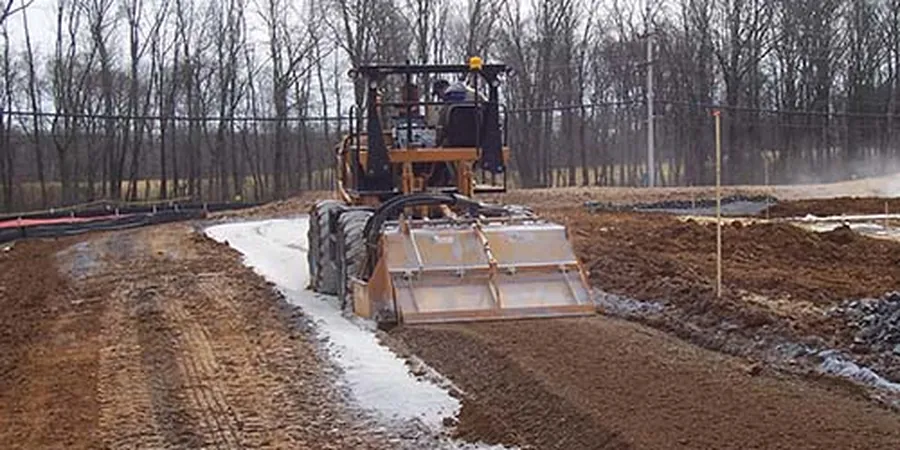
A recent street reconstruction project on Katella Avenue hit the typical Anaheim problem: a fat clay subgrade that turned into soup the moment the grader touched it. We stepped in with a lime treatment program, and within 72 hours the plasticity index dropped enough to place the first aggregate layer. That is the reality of soil stabilization for roads in this part of Orange County — you cannot just dump rock and hope for the best. Our laboratory runs the Proctor and CBR cycles before any additive goes into the mixer, so the dosage matches the actual soil moisture and density. For projects on tighter schedules we combine lime with a cement slurry, which accelerates the gain in California Bearing Ratio values. Before specifying any binder we always run the Atterberg limits test to confirm the clay is reactive enough for chemical treatment.
Without proper lime or cement treatment, Anaheim's plastic clays can lose 80% of their bearing capacity when the moisture content rises just 5% above optimum.
Method and coverage
Anaheim grew fast after the 1950s, and many residential streets were laid directly on natural alluvial fans without proper subgrade improvement. Today those same soils — silty sands with occasional clay lenses — cause differential settlement under asphalt when heavy trucks service the industrial parks near the 91 freeway. Soil stabilization for roads in this context means either mechanical densification or chemical modification, depending on the fines content. For sandy materials with less than 15% passing sieve #200 we prefer vibratory rolling combined with geocell confinement; for plastic clays we switch to lime or cement. A complete Proctor compaction test gives us the optimum moisture target, and the field density is verified with a nuclear gauge or sand cone. The treatment depth usually stays between 300 and 600 mm, enough to create a working platform that distributes traffic loads without rutting.
Technical reference image — Anaheim
Regional considerations
In Anaheim we often see contractors skip the mellowing period after lime application — they mix and compact on the same day, which leaves unhydrated lime pockets that later expand and crack the pavement. Another common mistake is applying cement to soils with high sulfate content without first checking the soluble sulfate concentration; the resulting ettringite formation can heave the road within months. Soil stabilization for roads in Anaheim requires strict quality control on the additive rate, mixing uniformity, and compaction moisture. Our laboratory always checks the PI and sulfate levels before recommending a stabilizer type, and we run a field strip test to verify the mix design before full-scale production begins. These steps prevent the kind of premature failure that leads to costly mill-and-overlay repairs.
Quicklime or hydrated lime mixed at 3-6% by weight, with a 24-72 hour mellowing period and re-compaction. Reduces PI, increases workability, and raises CBR to levels acceptable for residential and collector roads.
02
Cement Stabilization for Low-Cohesion Soils
Portland cement (Type I/II) applied at 4-8% for silty sands and low-plasticity clays. Achieves early strength gain within 7 days and allows traffic loading sooner than lime treatment alone.
03
Geosynthetic Reinforcement with Geocells
For sites where chemical treatment is not feasible (high sulfates or shallow groundwater), we design geocell-confined aggregate layers that distribute loads and prevent lateral spread. Verified with plate load tests after installation.
What is the typical cost range for soil stabilization for roads in Anaheim?
The cost for chemical stabilization (lime or cement) of a road subgrade in Anaheim typically falls between US$930 and US$2,780 per 1,000 square feet, depending on treatment depth, additive dosage, and site accessibility. Mechanical methods like geocell reinforcement tend to be at the higher end of that range.
How long does the lime stabilization process take before paving can begin?
After mixing lime into the subgrade, a mellowing period of 24 to 72 hours is required for the lime to react with clay minerals and reduce plasticity. Once re-compacted to the specified density, a 7-day curing period is typical before the base course and asphalt can be placed. The total turnaround from start to paving-ready is usually 10 to 14 days.
What soil conditions in Anaheim make stabilization necessary?
Anaheim's alluvial soils include expansive clays with plasticity indices over 30, as well as loose silty sands that compact poorly under traffic. Both conditions produce CBR values below 5% in the natural state, meaning untreated subgrades will rut or heave under standard roadway loads. Stabilization raises the CBR to at least 20% and controls volume change.
Do you provide field density testing after the stabilization is placed?
Yes. After the treated subgrade is compacted, we perform in-situ density tests using a nuclear gauge or sand cone method (ASTM D6938 / D1556). The results are compared to the target Proctor density from the mix design, and we issue a compaction report that engineers and inspectors use to approve the subgrade before paving.
Process video
Location and service area
We serve projects across Anaheim and surrounding areas.